Each actually good machine must understand its environment, however immediately’s AI techniques usually depend on power-hungry {hardware} and fixed cloud connections. That strategy creates a spot between what’s technically doable and what’s sensible for robots, autonomous autos, and different gadgets on the fringe of the Web of Issues (IoT).
Beneath the banner of “Bodily AI,” builders are pushing intelligence out of knowledge facilities and into sensors, cameras, and tiny modules—so machines could make split-second selections with out sending each body again to the cloud. Conventional cloud-based inference can introduce latency, unpredictable prices, and privateness considerations, driving the shift towards on-device AI or Edge AI.
On the coronary heart of this shift lies inference: the part of deep studying the place a educated mannequin takes new inputs—photos, video streams, sensor readings—and delivers real-time predictions. Not like coaching, which calls for huge knowledge units and heavy computation, inference is a streamlined “ahead cross” that should occur quick and sometimes with minimal energy.
Edge inference allows a supply drone to detect obstacles on the fly, a manufacturing facility digital camera to identify defects immediately, or a subway security system to set off alerts in milliseconds, with out ready on round-trip community delays (latency).
NeoVision, referred to as the “Mind of Issues” by Neowise, is designed to bridge this hole. Reasonably than adapting generic basis fashions, Neowise develops its personal inference engines from the bottom up. By tailoring every neural community and software program stack, NeoVision squeezes most efficiency into tiny footprints. The purpose is evident: run subtle imaginative and prescient duties on minimal {hardware} in order that even battery-powered gadgets can function and huge fleets of vision-capable techniques could be deployed with out onerous infrastructure prices.
To attain its power-saving ambitions, NeoVision faucets two frontier applied sciences. First, Silicon Photonics guarantees as much as 100× larger vitality effectivity than standard silicon chips by transmitting knowledge as gentle, not electrons. Second, Quantum Computing strategies intention to speed up key operations at fractions of immediately’s energy budgets.
Though each fields are nonetheless maturing, Neowise believes this twin-track funding will in the end slash inference-chip energy consumption by roughly 35× in comparison with GPU-style {hardware}—and drive complete system prices down by almost two-thirds versus legacy options.
Till just lately, techniques leaned on GPUs tethered to cloud servers for heavy lifting. Corporations struggled with 200-watt modules and 350-watt server racks—or confronted the trade-off of lower-precision fashions that missed refined defects or hazards. At present’s interim fixes embody hybrid architectures that break up workloads between the sting and knowledge middle, however they nonetheless add complexity and price.
Against this, NeoVision’s all-in-one chip-and-software answer retains each inference and occasional mannequin updates on the machine itself, reducing latency to microseconds and eliminating recurring cloud charges.
Neowise, based on April 12, 2024 is led by Charlie Shin (CEO) alongside co-founders Ned Jo (CTO) and Rocky Son (COO). From its early years, the startup has racked up milestones—an MVP of energetic studying by November 2024, a cloud-NPU pilot by December, and partnerships for subway security options in mid-2025. Its workforce combines deep experience in AI, photonics, and robotics, backed by a rising patent portfolio and strategic agreements with sensor producers and system integrators.
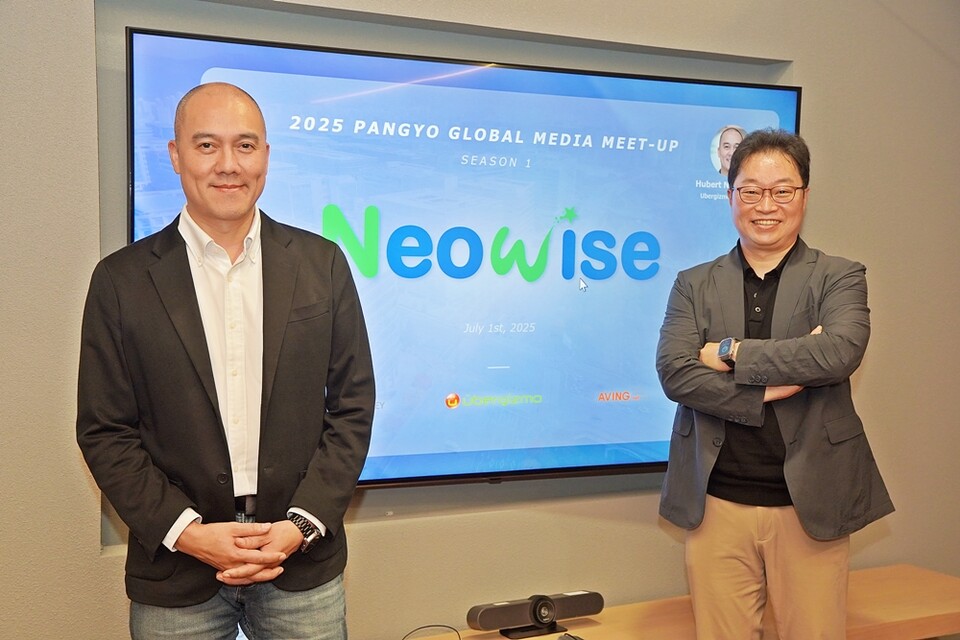
Neowise CEO Charlie Shin (proper), Ubergizmo Co-founder Hubert Nguyen (left) | Photograph by AVING Information
NeoVision’s business technique rests on 4 pillars. First, Neowise will license its proprietary knowledge units and foundational algorithms. Second, it affords vital capabilities—object detection, hazard warning, SLAM—via APIs or software program subscriptions. Third, it’s growing its personal NPU chips, cloud platform, and common SDK for seamless deployment.
Lastly, it plans to allow NPU-driven digital camera and robotic imaginative and prescient options so companions can construct customized edge-AI techniques with out reinventing the stack. The imaginative and prescient is daring, however as immediately’s Bodily AI wave accelerates, NeoVision goals to grow to be the go-to “mind” for any machine that should see and determine on the velocity of sunshine.
Filed in . Learn extra about AI (Artificial Intelligence), GPU (Graphics Processing Unit), Korea, Semiconductors and Startups.
Trending Merchandise
Wi-fi Keyboard and Mouse Combo R...
ASUS TUF Gaming 24” (23.8” view...

ASUS TUF Gaming 27″ 1080P Mon...
CHONCHOW LED Keyboard and Mouse, 10...

SAMSUNG 34″ ViewFinity S50GC ...

Acer Nitro 31.5″ FHD 1920 x 1...


HP 15.6″ Touchscreen Laptop c...